Phoney War
The LighthouseThe Phoney War marks the uneasy interval in which Emily Holcombe’s family and a small number of staff remained on Combe Island after war began, before evacuating in October 1940. In her account, the island’s apparent distance from danger did not make it safe: the shortage of fuel delayed departure, and the final night left a concealed history of fire, death and silence.
The Island During the Phoney War
Combe Island was not considered especially vulnerable to attack, but remaining there depended on the launch, and there was no fuel for it. The family therefore stayed through what Emily Holcombe describes as the year of the Phoney War. The island’s wartime isolation was practical as well as geographic: once departure became necessary, the remaining staff had to be taken to the mainland by boat.
By October 1940, circumstances had changed. France had fallen, and Emily’s brother had died at Dunkirk. Her parents decided to leave the island for their main house near Exmoor; Emily was due to go to Oxford the following year. The evacuation of the remaining staff was managed by the steward and Saul Oliver, whose work as Combe’s boatman made him central to the departure.
The Last Night on Combe
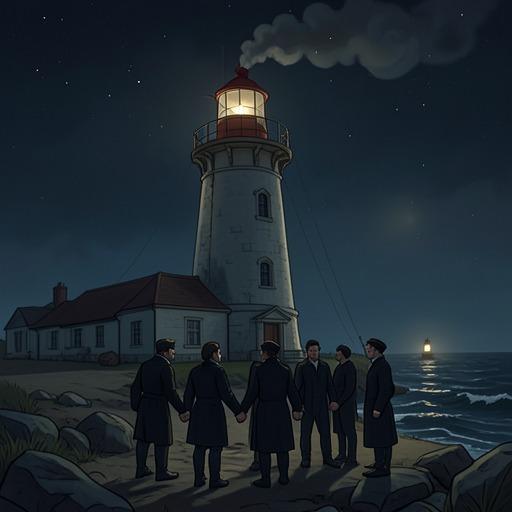
After landing the last staff on the mainland, Saul returned to Combe with his young son, Nathan Oliver. He said the house needed further securing and stayed for one additional night. On 10 October, three German officers from the occupied Channel Islands landed on the island. Their purpose remains uncertain: they may have been conducting reconnaissance or attempting a private exploit, and Raimund Speidel later thought they might have intended to raise a German flag on the disused lighthouse.
The three officers went up the lighthouse after first light. Saul discovered their boat and set fire to dry straw stored on the tower’s ground floor; flames and smoke rose into the upper chamber, trapping the men because the lantern railings were unsafe and its door had been nailed shut. All three died, probably of suffocation. Saul carried their bodies to their boat, took it out with the dinghy and scuttled it in deep water. The story turns the supposed lull of the Phoney War into a setting for an act whose evidence and motive would remain obscured for decades.
A Past Kept Uncertain
The official record described the three men as absent without leave after taking a thirty-foot sailing boat with an engine; they were posted missing, believed drowned. The family account was no clearer. Saul’s son Raimund Speidel learned that his father had disappeared with two fellow officers, but his family had left the circumstances largely uninvestigated, treating the convenient explanation of death on active service as preferable to scandal. Years later, Speidel came to Combe seeking information for his twelve-year-old son, who wanted to know about his grandfather.
Emily Holcombe’s account also preserves unresolved claims about the aftermath. She said Saul had taken Nathan, then four, with him and that Tom Tamlyn was present. After the Germans’ boat was destroyed, Saul and Tom returned to the island and later set out for the mainland with Nathan. Tom fell overboard, according to Saul; his body was found six weeks later with the back of the skull smashed. The coroner returned an open verdict, while the Tamlyn family believed Saul had murdered him to conceal the lighthouse deaths.
Emily further recalled Saul telling her that Nathan, playing with matches, had started the fire. She had believed him at the time but was no longer certain. These competing accounts prevent the interval from settling into a single, reliable version of events: official records, family reticence, local suspicion and belated recollection each preserve only part of the past.
Narrative Significance
The Phoney War functions as a hinge between ordinary island life and its buried wartime violence. The family’s departure in October 1940 creates the opportunity for Saul’s secret return; the fire and the officers’ disappearance then become the source of later questions, including Speidel’s search and the Tamlyns’ suspicion. The period’s name suggests a pause, but on Combe the apparent lull contains the event that makes the past persist in the present.